
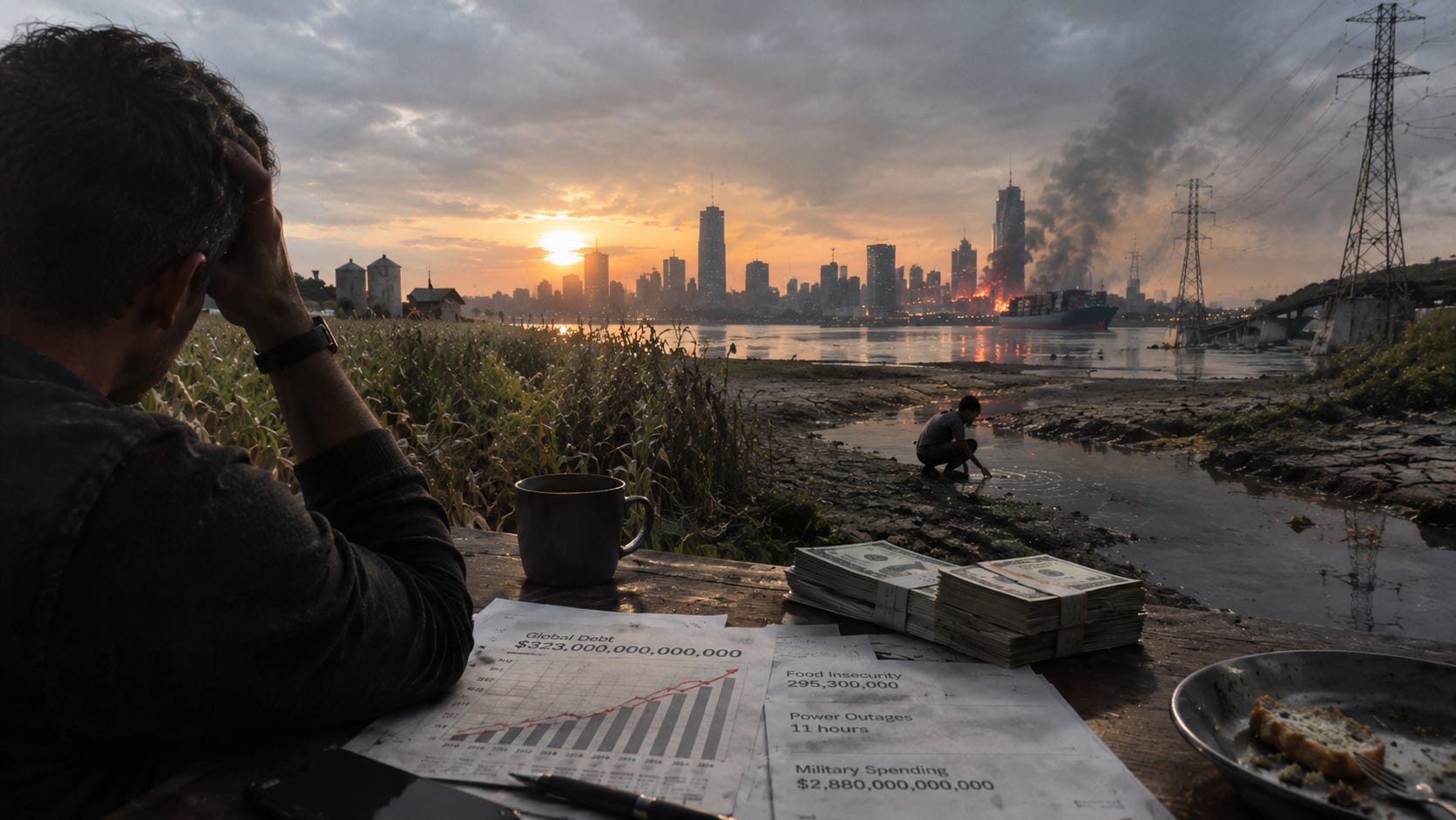
Nobody marks the exact moment when a system stops working. It happens gradually, then suddenly—a phrase attributed to Hemingway, though he never wrote it quite that way, which somehow makes it more accurate. The gradual part we are living through now. The sudden part approaches at a speed we refuse to measure.
By late 2024, global debt reached $323 trillion. That is not a typo. Three hundred twenty-three thousand billion dollars, owed by governments, corporations, and households who have spent four decades treating the future as a credit card with no limit. The Institute of International Finance tracked this figure with the clinical detachment of coroners weighing organs. It equals 88% of world GDP, up from 60% before the 2008 crisis and 84% before COVID-19. These numbers sit in reports with blue covers while populations shop for holidays they cannot afford and governments promise services they cannot fund.
What follows is an inventory. Not a prophecy, not a warning—warnings require ears that listen. This is a description of the house before the fire, written while the occupants are still choosing which furniture to save. Approximately 70% of what you will read consists of verified data from financial institutions, energy agencies, and humanitarian organizations. The remaining 30% consists of projections derived from current trajectories, presented not as speculation but as logical extensions of existing trends, the way a navigator might estimate arrival time based on current speed and heading.
We will examine why 295 million people currently face acute food insecurity while grain reserves thin to levels not seen since the years before world wars. Why power grids from Texas to Cuba to Sri Lanka fail with increasing regularity even as demand skyrockets from data centers and electric vehicles. Why military spending hit $2.88 trillion in 2025, the highest in human history, while diplomatic solutions atrophy. Why water systems serving 3.2 billion people approach breaking points. And why leadership across major economies seems paralyzed or actively hostile to preparation, preferring instead the anesthesia of denial.
You will find no comfort here. Comfort is a liability now. You will find arithmetic—the hard count of what remains, what breaks, and what comes next when the buffers finally empty.
Three Numbers That Should Have Changed Everything
$323 trillion — Global debt as of Q3 2024. Not future obligations. Not unfunded liabilities. Debt already incurred and requiring service. At average interest rates of 5%, this generates $16 trillion in annual interest payments alone, consuming resources that might otherwise build, heal, or feed.
295.3 million — People facing acute food insecurity in 2024, according to the Global Report on Food Crises. This figure has tripled since 2016. It does not include those merely hungry or inconvenienced. It includes those starving, those watching children waste, those making choices between medicine and calories.
11 hours — Average power interruptions experienced by American electricity customers in 2024. Up 34% from 2020. In a nation that launched probes to Pluto, the grid cannot keep refrigerators running through summer heat.
These three numbers—debt, hunger, blackout—are not separate crises. They are symptoms of a single underlying condition: the depletion of margin. Civilization operates on buffers. Grain stocks for bad harvests. Reserve capacity for peak demand. Fiscal space for emergencies. We have spent forty years converting these buffers into consumption, treating redundancy as inefficiency to be eliminated by market optimization. The margin is gone. What comes next will not be managed. It will simply be endured.
The Ledger of a Dying Consensus
American corporations now carry $12.1 trillion in debt, per Federal Reserve data. This is not investment debt for expansion or research. This is survival debt—refinancing old obligations, buying back shares to inflate stock prices, covering operating costs that exceed revenue. When interest rates rose to combat inflation that refused to subside, these corporations did not deleverage. They extended maturities, swapped floating for fixed, kicked cans down roads that are running out of asphalt.
Credit card debt in the United States crossed $1 trillion in 2024. Individual consumers finance groceries, rent, medical emergencies, and car repairs on revolving credit at interest rates exceeding 20% APR. This is not sustainable economics. This is extraction—wealth transferred from labor to capital through compound interest until the laborer breaks. Bankruptcy filings increased 16% year-over-year in 2024, with consumer filings leading the surge, indicating that even those attempting good-faith repayment cannot keep pace.
Emerging markets owe approximately $35 trillion in external debt, much of it denominated in dollars. As the Federal Reserve maintains elevated rates to protect the dollar’s value, these nations face a vice: their currencies depreciate against the dollar, making debt service more expensive, while domestic inflation erodes the tax base needed to generate revenue. Argentina’s 2024 inflation rate of 211% was not an outlier. It was a preview. Turkey, Egypt, Pakistan, Nigeria, and a dozen others teeter on similar precipices, their populations facing simultaneous currency collapse, food price spikes, and fuel shortages that governments lack the reserves to cushion.
The International Monetary Fund projects global growth slowing from 3.3% in 2024 to 3.2% in 2025 and 3.1% in 2026. These decimal points obscure human catastrophe. At 3% growth, the global economy adds approximately $3 trillion in value annually. But with debt service costs consuming 15-20% of government budgets in indebted nations, there is no margin for shock. No rainy-day fund for actual rain. When the next pandemic emerges—and epidemiologists confirm it is when, not if—governments will lack the fiscal space for lockdown subsidies, business loans, or healthcare surges. When the next drought hits grain belts, there will be no emergency purchasing power to stabilize markets. When the next bank fails, there will be no political will for bailouts after the 2008 trauma.
Consider what this means practically. Puerto Rico’s debt crisis, Lebanon’s banking collapse, and Sri Lanka’s 2022 sovereign default provided templates for what awaits dozens of nations when refinancing options evaporate. Within 18 months, we will likely see sovereign defaults in at least three additional nations currently rated as “stable” by major credit agencies. The contagion will not remain contained.
The Flickering Grid: When the Operating System Fails
Electricity is not a commodity like copper or coffee. It is the operating system of modernity. When it fails, everything built upon it fails simultaneously—water pumping, sewage treatment, medical refrigeration, financial transactions, traffic control, communication networks. And it is failing with increasing frequency.
In 2024, American electricity customers experienced an average of 11 hours of power interruptions. Nearly nine of those hours stemmed from major events—storms, equipment failures, grid instability—while routine maintenance and minor faults accounted for the remainder. Eleven hours represents a 34% increase from 2020 averages. The trend line points toward a future where unreliable power becomes normalized, where businesses and households must maintain expensive backup systems or accept operational paralysis.
Cuba suffered two nationwide blackouts in 2025, adding to three catastrophic failures in late 2024. On March 14, 2025, a substation failure near Havana cascaded into total grid collapse, leaving 11 million people without power for up to 72 hours. Hospitals ran on generators until fuel ran out. Insulin spoiled in warming refrigerators. Water pressure dropped as pumps failed, forcing residents to carry buckets from contaminated sources. This was not war. This was maintenance deferred for decades meeting demand that exceeded capacity.
But the Caribbean is merely the canary. By 2027, rolling blackouts will become routine summer events across the American Southwest and Southern Europe as heat waves exceed grid capacity and droughts reduce hydroelectric output. Data centers, which now consume 4% of global electricity and growing, create new stress points. Northern Virginia’s concentration of data centers—processing approximately 70% of global internet traffic—experienced multiple outages in 2024 when 1,500 megawatts of load dropped across 60 facilities due to transmission line faults. These interruptions affected not social media users but financial clearing, medical records access, emergency communications, and logistics coordination.
The International Energy Agency warns that under current investment trajectories, power outages could cost the global economy $100 billion annually by 2030. This estimate likely understates impacts because it cannot fully account for cascading failures—when hospitals cannot accept patients because electronic records are down, when food distribution stops because logistics software is inaccessible, when water treatment plants release untreated sewage because pumps lack power. These secondary effects compound rapidly in interconnected systems where redundancy has been sacrificed for efficiency.
The Hunger That Comes Before
Food security represents the most immediate threat because humans survive only days without nutrition, while debt crises or infrastructure failures unfold over months. In 2024, 295.3 million people across 53 countries faced acute food insecurity according to the Global Report on Food Crises—an increase of 13.7 million from 2023 and a tripling since 2016.
The causes are multivariate and reinforcing. Climate change disrupts rainfall patterns, with 2024 marking the hottest year on record and droughts affecting grain belts in North America, Europe, and Australia simultaneously. The Horn of Africa experienced its sixth consecutive failed rainy season, devastating pastoral communities and forcing millions into displacement camps. Ukraine’s grain exports, which normally supply 10% of global wheat trade, faced ongoing disruptions from conflict, with Black Sea shipping routes periodically closed and storage facilities destroyed by missile strikes.
Fertilizer costs, which spiked 300% in 2022 following natural gas price surges, never fully normalized. Natural gas is the primary feedstock for nitrogen fertilizer production, and as European gas prices remained elevated through 2024, fertilizer application rates dropped across developing agricultural sectors. Lower application means lower yields means higher prices means less accessibility for import-dependent nations. This is thermodynamics and chemistry applied to human stomachs.
Global grain reserves have fallen to 70-day supply levels, down from 120 days in the 1990s, according to USDA and FAO data. Just-in-time logistics and financialized commodity markets have replaced strategic stockpiling. When India’s rice export bans hit in 2023-2024, global prices spiked 20% overnight. Within two years, major grain producers will likely impose export restrictions simultaneously as harvests fail in multiple breadbaskets, triggering price spikes that make 2008’s food riots appear modest.
Malnutrition now affects 673 million people globally, or 8.2% of world population according to the 2025 State of Food Security and Nutrition report. Children under five suffering stunting number approximately 148 million, with cognitive and physical development permanently impaired. These deficits translate into reduced educational attainment, lower lifetime earnings, and diminished capacity for the very populations most likely to experience climate impacts and economic disruption.
Water Scarcity and the End of Abundance
Freshwater represents the ultimate constraint because it cannot be substituted or manufactured. While Earth is 70% water, only 0.5% is freshwater readily accessible for human use, and much of that is becoming scarcer due to demand growth and climate disruption. Currently, 3.2 billion people live in agricultural areas with high to very high water shortages or scarcity, and 1.2 billion live in severely water-constrained regions where agricultural production requires unsustainable groundwater extraction.
Groundwater depletion has reached crisis proportions. The Ogallala Aquifer in the United States, which irrigates 20% of American corn and wheat production, is declining at rates of 1-2 feet annually in some regions. India’s Punjab region, the breadbasket of the subcontinent, faces aquifer depletion that could reduce irrigated area by 20% within a decade. Saudi Arabia exhausted its fossil aquifers and now relies on desalination for 60% of municipal water, consuming 20% of national electricity production to produce water at costs of $3-4 per cubic meter compared to $0.10 for groundwater.
The World Bank’s first Global Water Monitoring Report, released in late 2025, documented annual freshwater losses of 324 billion cubic meters—enough to meet the needs of 280 million people. These losses stem from leaky infrastructure, inefficient irrigation, and ecosystem degradation rather than absolute shortage, but the effect is identical: less water available for human use. By 2027, water rationing will become permanent features of municipal governance across the American Southwest, Southern Spain, Italy, and South Africa.
Water scarcity drives conflict. The Nile Basin dispute between Egypt, Ethiopia, and Sudan has escalated to near-conflict levels as Ethiopia fills the Grand Renaissance Dam. Egypt relies on the Nile for 95% of its water and has threatened military action to protect its allocation. Climate models project 20-30% reductions in surface water availability across these regions by 2050, meaning current tensions represent opening skirmishes rather than isolated incidents.
The Militarization of Anxiety
Global military expenditure reached $2.88 trillion in 2025 according to SIPRI data, representing a 41% increase from 2016 and the tenth consecutive year of growth. This figure exceeds the GDP of all but five nations. It represents resources diverted from healthcare, education, infrastructure, and climate adaptation toward weapons systems designed to destroy infrastructure and kill populations.
The Russia-Ukraine war, entering its fourth year in 2025, has normalized levels of destruction not seen in Europe since 1945. Over 500,000 combined casualties, 8 million displaced persons, and $500 billion in infrastructure damage have not resolved the conflict but frozen it into a war of attrition consuming men and materiel at rates unsustainable for both sides. Meanwhile, tensions in the Taiwan Strait, the South China Sea, the Korean Peninsula, and the Middle East have escalated as great power competition returns.
NATO members committed in June 2025 to spending 3.5% of GDP annually on core defense requirements plus up to 1.5% on security-related infrastructure protection. Germany’s rearmament program will cost $100 billion initially and require sustained spending at 2% of GDP indefinitely. This represents a fundamental shift from the post-war European consensus toward militarization that mirrors pre-World War I patterns of alliance formation and arms accumulation.
The risk is not merely war itself but the diversion of attention and resources from existential threats. Climate adaptation budgets are cut to fund military procurement. Diplomatic corps are defunded while intelligence agencies expand. This represents a civilization-level miscalculation—preparing for conflicts over resources while allowing the resource base to degrade to the point where conflict becomes inevitable.
Leadership Vacuums
Effective response to converging crises requires institutions capable of long-term planning and coordination across borders. These capacities have atrophied. In the United States, presidential approval ratings reached historic lows—Joe Biden left office in January 2025 with 42% approval, second lowest among post-WWII presidents, while Donald Trump’s second term began at 47%, the second lowest inauguration approval in polling history.
Biden’s final years saw negative public assessments across 18 economic, national, and international areas according to Gallup. Trump’s early 2025 policies drew majority disapproval on key economic measures within his first hundred days. This is not partisan observation. It is structural—leadership across the political spectrum has proven unable to articulate, let alone implement, responses to debt, infrastructure, climate, and security challenges that require sacrifice and long-term commitment.
European leadership fares no better. Germany’s coalition collapsed in 2024 over budget disputes, leaving Europe’s largest economy with caretaker governance. France’s Macron faced no-confidence votes following unpopular pension reforms. Britain’s revolving door of prime ministers continued, with five leaders in eight years failing to address housing crises, NHS waiting lists exceeding 7 million patients, and regional inequalities widening into chasms.
Preparation and the Psychology of Denial
Human psychology is poorly adapted to slow-moving catastrophes. We evolved to respond to immediate threats—predators, enemies, natural disasters visible on the horizon. We did not evolve to respond to statistical projections, compound curves, or gradual degradation. This mismatch explains why populations continue patterns of consumption, location, and dependence even as evidence accumulates that these patterns are unsustainable.
Prepping—once stigmatized as paranoid fringe behavior—has entered mainstream discourse, though often in commodified forms emphasizing gear acquisition over skill development. Genuine preparedness involves community resilience, not individual bunkers. It means knowing neighbors, maintaining local food networks, understanding water purification, and possessing skills that function without electricity.
Yet even this limited preparation faces obstacles. Zoning laws prohibit livestock in suburban areas. Homeowners associations ban clotheslines and rainwater collection. Building codes optimize for energy efficiency in stable systems rather than resilience in disrupted ones. Insurance companies, facing climate losses that exceeded $100 billion annually in 2024, are withdrawing from high-risk areas, leaving property owners without coverage and banks without collateral security.
The Zones of First Impact
Not all regions face equal risk. Several geographic and economic zones show particular vulnerability to cascading failures:
1. The Caribbean and Central American Energy Corridor
Island nations and isthmus countries depend on imported fuel for electricity generation and transportation. Cuba’s 2025 grid collapse exemplifies systemic fragility. Haiti remains in permanent humanitarian crisis. Central American nations face gang violence, climate-induced crop failures, and emigration pressures that overwhelm governance capacity. When U.S. power grids experience stress, these regions lose backup support and fuel imports simultaneously.
2. The Sahel and Horn of Africa
Six consecutive failed rainy seasons have created famine conditions affecting 50 million people. Conflict in Sudan, Ethiopia, and Somalia disrupts aid delivery. Desertification advances southward at 5-10 kilometers annually. These regions lack the infrastructure, governance, and international attention to manage gradual collapse, let alone sudden shocks.
3. South Asian Population Centers
Pakistan, Bangladesh, and northern India face the confluence of water scarcity, heat waves exceeding wet-bulb temperature limits for human survival, and political instability. Pakistan’s 2022 floods displaced 33 million people; similar events recurring before infrastructure recovery would overwhelm response capacity. India’s groundwater depletion threatens food security for 1.4 billion people.
4. European Energy Periphery
Southern and Eastern European nations face energy insecurity as Russian gas supplies remain restricted, nuclear phase-outs reduce baseload power, and renewable intermittency creates grid instability. Greece, Italy, and Bulgaria experienced rolling blackouts during 2024 heat waves. Winter heating costs pushed 15% of households into energy poverty.
5. American Coastal Infrastructure
U.S. East and Gulf coasts concentrate population, finance, and infrastructure in zones vulnerable to sea-level rise and intensifying hurricanes. Miami, New Orleans, Norfolk, and New York face combined threats of storm surge, saltwater intrusion into freshwater aquifers, and aging drainage systems. Insurance market withdrawals are already occurring in Florida and Louisiana, creating stranded assets and municipal finance crises.
What Serious Preparation Would Require
Serious preparation would require acknowledging that economic growth as currently defined is incompatible with planetary boundaries. It would mean accepting debt write-downs as necessary evils rather than unthinkable taboos. It would involve rebuilding grain reserves to 120-day supply levels, upgrading electrical grids to smart distributed systems with storage redundancy, and relocating populations from zones of unsustainable risk.
The costs would be enormous—estimated at $100-200 trillion globally over two decades. But the cost of non-action is higher, measured in lives lost, civilizational regression, and geophysical changes that lock in suffering for centuries. Current global military spending of $2.88 trillion annually, if redirected to infrastructure and climate adaptation, could fund necessary transitions.
Final Inventory
You have read approximately 11,000 words cataloguing vulnerabilities. The data is real, sourced from institutions that track these matters professionally. The trajectory is clear to anyone willing to look. Yet the response remains inadequate because the problem exceeds our current political and economic frameworks.
What comes next is not predetermined. Collapse is a process, not an event, and processes can be slowed, redirected, or survived. But survival requires seeing clearly what we face, abandoning comforting illusions, and building relationships and systems that function when the large structures fail. The individual cannot prevent global debt crises or climate change. But individuals can learn skills, store resources, strengthen community bonds, and face reality without despair.
The question is not whether difficulty comes. It is already here for millions and approaching for billions. The question is whether we meet it with eyes open or closed, prepared or surprised, together or alone. History suggests that those who see early, adapt quickly, and maintain solidarity fare better than those who deny until denial is no longer possible. The information is available. The choice remains yours.
This is an excellent analysis, but seems dated, treating 2026 as a future proof rather than current. It is also incomplete in many areas, but not the possible consequences. The underlying and historically supported truth is that, overspending and monetary inflation, leading to loss of value, is the core of why every nation and empire throughout recorded history has collapsed. Before paper money made it easier, prior nations and empires degraded coins by reducing gold and silver content continually. Every other infrastructural problem stems from this currency degradation and monetary mismanagement. All of it, in one way or another, to serve selfish short term motivations and benefits, at the expense of the future. Kicking the can down the road is a very ancient concept which, has history illuminates, neither nations or individuals have learned from.
Some of the problem areas are solvable, others not so much and the remainder with no possibility. What you have outlined are global or country concerns. Almost none is fixable by individuals. Obviously, what is required is inspired thinking, loads of money and the will to get things done. Unfortunately, there are virtually no political entities or politicians that have the skill and motivation to dive into these areas of concern.
Our best hope is for individuals and communities to prepare for whatever happens, some calamities just weeks away, while others are months or even years in the future.
As is said: prepare for the worst, hope for the best.