
A million people live in Kaliningrad, a Russian territory that borders no friendly country. Squeezed between Poland and Lithuania and severed from the Russian mainland since 1991, it can be crossed by car in under two hours. The Baltic Fleet is stationed there, along with Iskander launchers, S-400 batteries and a network of radars and jammers that reaches well into Polish and Lithuanian airspace.
On the first day of October 2026, Vladimir Putin turned that small exclave into the subject of a warning aimed at the whole alliance. Speaking at the Valdai Discussion Club outside Moscow, he said that any attempt to cut Kaliningrad off from Russia would be met with “all weapons” at Moscow’s disposal, nuclear ones included. He then added something that received less attention than it deserved: “The point of no return can arrive very quickly and unexpectedly for everyone.”
Mark Rutte, NATO’s secretary general, confirmed that the alliance had received the message directly. What the two sides disagree about is whether NATO is genuinely preparing to blockade the exclave or merely posturing. That dispute matters less than the ground beneath it. Between Kaliningrad and Belarus lies the Suwałki Gap, a strip of Polish and Lithuanian territory about 65 kilometers wide and the only overland connection between the three Baltic states and the rest of NATO. Close it and Estonia, Latvia and Lithuania become islands.
Forces at both ends of that corridor can now carry nuclear weapons, and both sides spent 2026 rehearsing the war that would use it. The story of how Europe reached this point is not one of sudden crisis. It is a story of structures being dismantled while the rhetoric around them grew louder, which is harder to notice and considerably harder to repair.
Understanding it requires separating things that are usually blurred together. There is capability — what weapons exist and where. There is doctrine — the rules, written and unwritten, for when they would be used. There is signaling — what leaders say and what they expect the other side to conclude. And there is friction — the daily collisions that occur when two armed forces operate close enough to misread each other. Most of 2026 moved on the last two layers while the first two quietly eroded, and that combination is what makes the current moment more dangerous than the volume of the shouting alone suggests.
The treaty that expired
The most consequential nuclear event of the year drew a fraction of the coverage given to a single Putin speech. On 5 February 2026, New START — the last remaining arms control treaty between Washington and Moscow — lapsed, and nothing took its place (Council on Foreign Relations; Vienna Center for Disarmament and Non-Proliferation).
Signed in 2010, the treaty had capped each side at 1,550 deployed strategic warheads on 700 delivery systems. Those ceilings were large enough that their numbers never captured the imagination. The real value lay elsewhere, in verification: on-site inspections, data exchanges and notifications that let each side see the other rather than infer. Verified information restrains behavior, because it removes part of the incentive to plan for the worst case.
That machinery had been failing long before the deadline. Russia suspended inspections during the pandemic and never fully resumed them. Washington accused Moscow of technical violations even as the war made cooperation impossible. By the time the treaty expired, both sides had drifted into a condition specialists describe as “no verification,” meaning each is now guessing about the other’s arsenal — and guessing tends toward pessimism.
Expiry was also a decision, not simply an accident. The Trump administration showed little urgency about extension, arguing that any new agreement should include China and cover every Russian warhead rather than only the strategic ones aimed at America. Both arguments are sound, but they are medium-term arguments applied to a short-term vacuum. Bringing China into a bilateral framework takes years, and in the meantime the two largest nuclear arsenals on earth operate without constraints for the first time since 1972.
An earlier treaty had died in similar fashion. The Intermediate-Range Nuclear Forces Treaty, signed by Ronald Reagan and Mikhail Gorbachev in 1987, abolished an entire category of weapon: ground-launched ballistic and cruise missiles flying between 500 and 5,500 kilometers. It removed the SS-20s and the Pershing IIs from Europe and, for a generation, quieted the specific fear of a short-warning nuclear exchange confined to the continent. Washington withdrew in 2019, citing Russian violations, and Moscow followed. Seven years later, the consequences of that absence are shaping the map.
In November 2024, Russia fired a new intermediate-range ballistic missile at a Ukrainian industrial site in Dnipro. The weapon was called the Oreshnik, named for the clustered arrangement of its warheads. Ukrainian intelligence claimed it had flown faster than Mach 11; Russia claimed it could not be intercepted. Both assertions deserve caution, since independent verification is difficult and both sides have an interest in the answer. What nobody disputes is that a missile the INF would once have regulated had been used in combat.
Since then the Oreshnik has become Moscow’s most visible instrument of signaling. It struck the Lviv region on 9 January 2026 and the area near Bila Tserkva, outside Kyiv, in May. Damage from the early strikes was modest, which is largely the point. The system functions less as a battlefield weapon than as a delivery mechanism for a message: a nuclear-tipped missile can reach a European capital in minutes rather than the half hour a true intercontinental shot would need.
Then came the deployment that mattered most. By late 2025, Russia claimed the Oreshnik was being stationed in Belarus, and by early 2026 satellite imagery plus statements from Minsk, Moscow and Ukrainian intelligence pointed the same way. A dual-capable intermediate-range ballistic missile now sits a few hundred kilometers from Vilnius and the Polish border. Preventing exactly that was the reason the INF existed in the first place.
On 27 January 2026, the Bulletin of the Atomic Scientists moved its Doomsday Clock to 85 seconds to midnight, four seconds closer than the previous year and the nearest the clock has stood to disaster since its creation (Bulletin of the Atomic Scientists, 27 January 2026). The dial is a judgment rather than a calculation, and it compresses nuclear risk together with climate risk and, more recently, the risk from disruptive technology. Its virtue is that it forces a periodic reckoning; its weakness is that it can read as atmosphere rather than analysis. The board’s stated reason for the move was structural — a failure of leadership among the nuclear powers and the simultaneous unraveling of the agreements that had kept their competition bounded. It was reacting less to a crisis than to the disappearance of the machinery that used to absorb crises.
Bombs under borrowed flags
While the treaties vanished, NATO’s nuclear-sharing arrangement quietly widened, and the arrangement is stranger than most accounts admit.
Under nuclear sharing, the United States keeps roughly 100 B61 gravity bombs in Europe across six bases in five countries: Kleine Brogel in Belgium, Büchel in Germany, Aviano and Ghedi in Italy, Volkel in the Netherlands, and Incirlik in Turkey (Federation of American Scientists; Center for Arms Control and Non-Proliferation). The bombs are American. The aircraft that would deliver them usually are not. In a crisis, allied pilots would fly American weapons under a dual-key arrangement, giving non-nuclear NATO members a physical stake in the deterrent.
The current model is the B61-12, a guided, variable-yield version that replaced older variants. The family dates to the 1960s, and the 12 is the newest and the one that most concerns planners, largely because its improved accuracy allows it to be employed at lower yields. A weapon that can be used with less collateral damage is a weapon commanders are more willing to reach for, and the line between tactical and strategic use grows thinner when a bomb can be dialed down.
By August 2026 the argument had reached Poland. Deputy defense minister Paweł Zalewski said Warsaw wanted a role in nuclear deterrence without hosting warheads on its soil, a position he later qualified by pointing to NATO’s dual-capable aircraft program, under which Polish F-16s and F-35s would carry the bombs rather than store them. No current host sits closer to Russia except the Baltic states, and the idea of stationing American nuclear weapons in Poland has circulated for years without arriving.
American officials separately opened talks about basing additional nuclear-capable bombers in Europe, according to reporting in June 2026 (Euronews). The direction of travel is clear: more visible hardware, more rotations, positioned nearer the eastern flank. Whether that strengthens deterrence or simply adds targets is a live question.
The most consequential shift of the year, though, happened in Berlin, and it happened slowly enough that most people missed it. Germany spent 2026 asking whether it could still rely on the American nuclear guarantee. The trigger was Donald Trump: his persistent skepticism about NATO, his pressure on allies to spend more, and the more basic problem that a security guarantee is worth less when the guarantor might change his mind. Trust in the American umbrella has not been this politically fragile since the Cold War, and German officials responded with unusual candor.
In January, Chancellor Friedrich Merz said Berlin was exploring a shared European nuclear umbrella with allies, intended to complement the American one rather than replace it (Reuters, 29 January 2026). By March, France and Germany had established a nuclear steering group and agreed to deepen cooperation on deterrence (Reuters, 2 March 2026). By July, Emmanuel Macron was describing Germany as a “vanguard” of European nuclear deterrence, with French jets potentially operating from other countries’ bases and German and allied conventional forces playing supporting roles, while Paris kept sole authority over the trigger.
That final detail is the hard part. France’s force de frappe is a national arsenal, built to defend France, and any extension of its protection to Germany and its neighbors is a political promise rather than a legal commitment. Merz knows this; so does Macron. Both governments have therefore moved toward cooperation without pretending it substitutes for the American arsenal.
Not everyone wants to hurry. German defense minister Boris Pistorius has argued that US guarantees remain indispensable and that talking too loudly about a European deterrent sends the wrong signal, as though the Americans were already leaving. NATO’s Rutte tried to settle the room in February by insisting that nobody in Europe was pushing to replace the US umbrella (Agence France-Presse, 14 February 2026). Both remarks were true, and both were reassuring in a way that suggested they needed saying.
Arithmetic constrains the ambition. France holds the only independent nuclear arsenal in the European Union, numbering fewer than 300 warheads. Britain has a comparable force, tied to NATO and, in practice, to the American system. Together, the two European deterrents are substantial but far smaller than the American and Russian arsenals that overshadow the continent. A European umbrella, however generous, would remain a supplement.
Forward bases and rehearsals
Russia’s answer to all of this was to push more of its own hardware forward, and the obvious place to push it was Belarus.
Governed since 1994 by Alexander Lukashenko, Belarus had been drifting toward its larger neighbor for years before the war finished the job. By 2026 the country hosted Russian tactical nuclear weapons, the Oreshnik system and, for the first time, Russian troops training alongside Belarusian forces on the actual employment of nuclear weapons. Because Belarus borders Poland, Lithuania and Latvia, a missile based there shortens warning time for Warsaw and the Baltic capitals to almost nothing.
Lukashenko’s position deserves a note. He built a career on balancing Moscow against the West, and the war stripped him of the room to balance. He is now, in practice, a junior partner in a nuclear arrangement he cannot control, receiving prestige and a shield in exchange for autonomy.
Exercises offer the clearest window into what militaries actually intend, because they rehearse the difficult parts. On 19 May 2026, Russia began three days of drills involving both halves of its nuclear forces, the strategic triad and the shorter-range tactical weapons, with Belarus participating. More than 64,000 troops took part (OSW Centre for Eastern Studies, 25 May 2026). By Putin’s own account, it was the first time the two countries had practiced commanding strategic and tactical nuclear forces together.
“Today, as part of the exercises, we are conducting the first joint training of the armies of Russia and Belarus on managing strategic and tactical nuclear forces,” he said, speaking by video link beside Lukashenko (Kremlin transcript, May 2026).
The operational details carry more information than the headline. Belarusian crews practiced receiving “special munitions” — the term for warheads — and mating them to Iskander missiles from unprepared positions, rehearsing the fast, improvised version of deployment rather than the polished parade version. In the run-up, Russia test-fired a Sarmat intercontinental missile intended to replace the old Soviet SS-18 and reportedly scheduled to reach operational status by the end of the year. Putin framed the sequence as proof that the Russian-Belarusian nuclear triad must continue to serve as “a reliable guarantor of the sovereignty of the Union State.”
Three features of the exercise stand out. It was unannounced, which is itself a signal. It coincided with a spell of unusual Russian messaging over Kaliningrad. And it came three months after New START had died, in a period when neither side could inspect the other.
The friction layer
Nuclear doctrine stays abstract until something cheap crosses a border, and something cheap has been crossing borders for years.
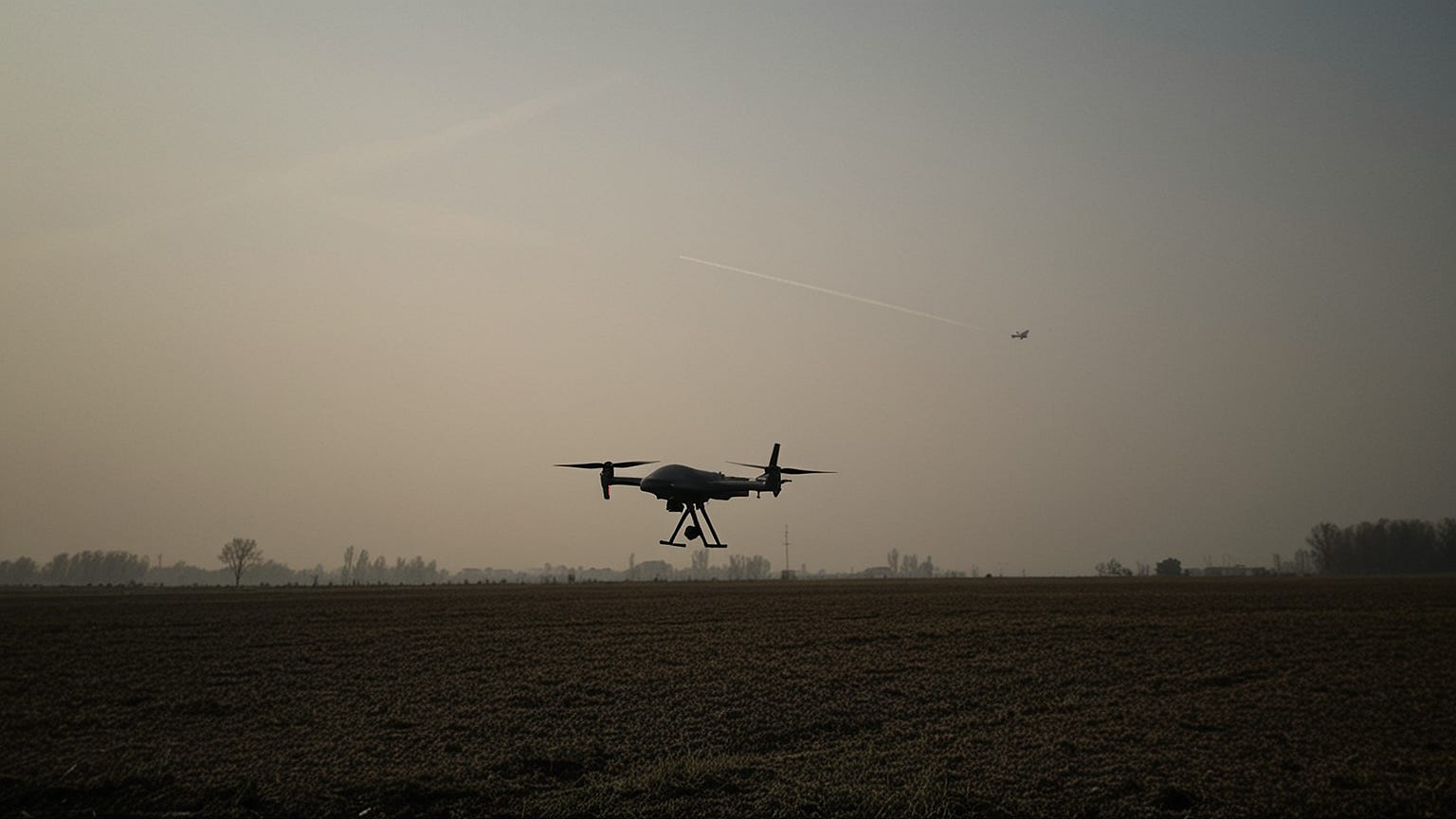
Since 2022, Russian drones and missiles aimed at Ukraine have repeatedly wandered into NATO airspace, with confirmed or suspected violations logged by Romania, Poland, Lithuania and Latvia. Most were accidents of geography and jamming; some were not.
The pattern sharpened through 2025 and 2026. Poland reported nineteen drone incursions in a single September 2025 night and invoked Article 4, NATO’s consultation clause, which sits one rung below the Article 5 commitment that an attack on one member is an attack on all. Allied jets downed drones over Polish territory (CNN, September 2025). Romania came close to the same step in May 2026 after a drone wounded two civilians on its soil (New York Times, 29 May 2026). By August, the North Atlantic Council met specifically over the incursions and pinned “full responsibility” on Russia (NATO, 12 August 2026).
Two structural problems sit beneath these incidents, and both matter more than any individual intrusion.
The first is the erosion of the response ladder. Article 4 has now been invoked often enough to lose its shock value, and the entire logic of NATO’s escalation management depends on each rung carrying weight. If the consultation clause becomes routine, the perceived distance between a stray drone and a nuclear threat shrinks, until a single dead soldier in the wrong field begins to look like the trigger for something much larger.
The second is asymmetry. Russia can probe NATO airspace with cheap, expendable machines and lose little when they are shot down. NATO must decide within minutes, at three in the morning, with a radar screen full of contacts, whether each incursion is a message, a mistake or a test. Cheap probes against expensive decisions is a favorable ratio for the probing side.
Russia’s nuclear doctrine, revised in late 2024, sits above this friction without resolving it. Much of the immediate commentary read the revision as a dramatic lowering of the threshold, though a cooler reading suggests it largely codified what Moscow had already been doing while adding a few formal hooks. The revision widened the conditions under which Russia might use nuclear weapons and stated that an attack by a non-nuclear state backed by a nuclear power could be treated as a joint attack. Read plainly, that covers Ukraine, backed by the United States and Britain. It also stretches the definition of aggression to include things short of invasion: air and space strikes, drone swarms, cross-border raids.
What the doctrine declines to supply is a number. There is no threshold — in warheads, kilometers or casualties — at which Russia has promised to go nuclear. The ambiguity is deliberate, since vagueness lets a threat cover a range of situations, and it is also what makes the doctrine unsettling, because nobody, perhaps not even parts of the Russian general staff, can say precisely where the line falls. Putin’s October remarks fit the pattern. “All weapons” for Kaliningrad is not a doctrine so much as a mood, delivered at a forum, that the West is expected to decode.
Distinguishing doctrine from signaling matters here. Doctrine is what a state has committed to; signaling is what it wants you to believe it has committed to. Russia’s advantage in this standoff lies in signaling heavily while committing lightly, which preserves options, though repeated signaling without action eventually dulls.
Alongside the practical systems, Russia maintains a stable of exotic weapons whose primary function is psychological. The Burevestnik is a cruise missile powered by a miniature nuclear reactor, which Putin says is in its final stages; its selling point is a range limited only by the reactor’s endurance, allowing it to loiter and approach from an unexpected direction, though its early test record was uneven. Poseidon is a nuclear-powered unmanned underwater vehicle, effectively a very large torpedo, designed to detonate near a coastline and generate a radioactive wave, launched from submarines and difficult to track. Then there is Sarmat, the heavy intercontinental missile meant to replace the Soviet SS-18, and Avangard, a hypersonic glide vehicle carried on modified older boosters. Sarmat’s testing has been uneven, and the Kremlin has pushed it toward service regardless.
How much these change the balance is easy to overstate. A warhead delivered by a new missile destroys the same city as a warhead delivered by an old one. What the novel systems shape is psychology — among leaders, markets and voters — and in a standoff, psychology forms a real part of the equation without forming the whole of it.
The war underneath, and what the money buys
None of this happens in a vacuum. It happens beneath a war now past four and a half years, one that keeps outliving every prediction of its end.
The diplomatic record of 2026 reads as a list of near-misses. Washington set a June deadline for a deal in February. Trump secured a three-day Orthodox Easter ceasefire in May, which Zelensky said Russia then breached. Ukraine floated an “energy ceasefire,” a mutual halt to strikes on power infrastructure, conditional on reciprocity and American guarantees. Kyiv’s envoy to the United Nations warned that Ukraine’s patience “is not endless” and that its offer might expire (Guardian, June 2026). By October, Ukraine’s foreign ministry said it was ready for five separate ceasefire arrangements, all dependent on Moscow’s consent (Ukrainska Pravda, 7 October 2026).
On the first of that month, Putin ruled out a long-range-strikes ceasefire at Valdai and, in the same address, warned the West over Kaliningrad (Al Jazeera, 1 October 2026). The two statements belong together, because the war and the nuclear standoff have become one conflict fought at different temperatures.
What sustains the standoff is a shared belief that time favors the other side. Moscow reckons Western resolve will crack as costs and domestic politics accumulate; Kyiv and its backers reckon Russia’s economy and manpower will eventually force a settlement. Neither has been proven right, so the war grinds on and the nuclear question waits beneath it. As long as both sides believe they are winning slowly, neither has a reason to accept a compromise that would matter at the nuclear level.
Europe’s answer has been to spend, and to keep discovering that spending is the easier half of the problem. NATO adopted a 5 percent of GDP spending target in 2025, a figure that would have seemed absurd a decade earlier. The European Union launched ReArm Europe, mobilizing up to 800 billion euros, plus a 150 billion euro loan facility for joint procurement. Germany amended its constitution to unlock borrowing for defense and infrastructure. A European “drone wall,” a chain of sensors and interceptors along the eastern flank, began moving in 2026, and the EU’s defense budget has nearly doubled since 2021.
The obstacles are structural rather than financial. Procurement remains fragmented across dozens of national champions and competing specifications, and the European Defence Agency has warned that current national plans still fall short on air defense, ammunition and naval power. Fiscal strain compounds the difficulty. The European Central Bank estimates that the extra defense spending will add roughly 0.4 percentage points to euro-area growth over 2025–2028 with only slight inflation, because most of it buys equipment rather than pays salaries — the favorable reading. The unfavorable one is that the weakest budgets, nearest Russia, can least afford the buildup unaided, and the countries feeling the threat most sharply often carry the least fiscal room and the highest emigration.
Beneath the fiscal problem sits a political one that receives the least attention and carries the most risk. Rearmament requires voters to accept trade-offs against welfare, health and pensions, and it requires them to sustain that acceptance for a decade rather than a news cycle.
Scenarios, and the limits of the picture
Scenarios are useful only when they specify the conditions that produce them.
Accident comes first, and requires no decision by anyone, which makes it the most likely. A drone drops in the wrong field; a missile strays during a barrage aimed at Ukraine; a fighter and an air-defense battery misread each other at three in the morning. The system has absorbed dozens of such moments and needs to fail only once. Poland’s 2025 Article 4 invocation and Romania’s 2026 near-miss were the rehearsals.
The Baltic comes next. Kaliningrad and the Suwałki Gap give both sides a place where the stakes are enormous and the distances are tiny. If Russia tests Article 5 with a limited push — a slice of the corridor, a “little green men” operation in Narva, a squeeze on the exclave — NATO would face a choice between a response that looks weak and one that risks escalation. Probing is cheap, which makes this plausible.
Third comes the collapse of the last limits, which needs only time and is already underway. With New START gone and no replacement, both sides can expand and modernize without a ceiling, and adding China’s buildup worsens the arithmetic.
Fourth is the war itself. If Ukraine’s lines break, or if Russia’s economy cracks, the losing side’s appetite for escalation grows. A nuclear demonstration — a single tactical detonation over an empty field or a Ukrainian port — is the option most discussed. This pathway depends on a battlefield or economic trigger rather than on the nuclear balance directly.
Fifth is the one that unsettles people who study machinery rather than maps. Warning systems, command links and the decision windows available to leaders are all strained, and New START’s inspection regime was, in part, a confidence-building machine. Remove it and two aging arsenals face each other, hoping the telephone line still works.
Honesty requires stating what is not known, because much of the certainty in this debate is borrowed. The precise condition of Russia’s arsenal is now inferred rather than verified. Stockpile estimates are credible but inexact. Claims about the Oreshnik’s speed come from one side or the other. The status of Belarus’s warhead storage was, as of early 2026, indicated by imagery and statements rather than confirmed directly. The Burevestnik and Poseidon are described by their developer as near completion, which is not the same as operational, and Sarmat’s service timeline has slipped before. On the European side, the debate over a shared deterrent runs ahead of the structures that would support one, and French willingness to extend protection is a political posture that could shift with an election.
What is reasonably firm is the shape of the problem: treaties gone, intermediate-range weapons back, forward bases nearer to each other, friction points multiplied. What remains genuinely uncertain is whether any of it produces a crisis, or whether it produces a long, expensive, quiet competition that everyone eventually normalizes.
A few things now look fixed in place. Europe will keep spending and building air defense, and it will keep discussing a European deterrent without quite creating one, because creating one demands a degree of political integration the EU has never reached. France and Germany will keep edging toward nuclear cooperation while Germany keeps insisting that the American guarantee remains indispensable, both because it is true and because saying otherwise would rattle markets and voters. Russia will keep leaning on Belarus, keep testing new systems and keep using the nuclear threat to shape Western politics rather than to win a war. Arms control will stay dead for a while and then, probably, return, because both sides will eventually rediscover that an unbounded competition costs more and frightens more than a bounded one.
The Doomsday Clock does not measure the odds of nuclear war. It measures how much error the system can absorb before one mistake becomes the final one. In 2026 the system absorbed a great deal. A treaty died, a new missile found a new home, jets shot drones out of the sky over a NATO member, and a president warned that the point of no return could arrive “very quickly and unexpectedly.” On the eastern edge of the continent, a million people went to work each day in a city that could become, on a bad morning, the place where everyone finally learns whether the whole thing still works.
What distinguishes the present moment from the long standoff that preceded it is not the rhetoric, which has been loud before. It is the removal of the structure beneath the rhetoric. The treaties that bounded the competition are gone, the verification that reduced mistrust is gone, and the intermediate-range weapons the INF once abolished are back, closer to the front line than at any point since the 1980s. Europe and Russia are not drifting toward nuclear war because anyone decided to. They are drifting because the paperwork ran out and nobody in a position to replace it treated the deadline as urgent.
Sources drawn on include the Bulletin of the Atomic Scientists, the Federation of American Scientists, the Center for Arms Control and Non-Proliferation, the Council on Foreign Relations, the Vienna Center for Disarmament and Non-Proliferation, Reuters, Agence France-Presse, the Guardian, Al Jazeera, CNN, the New York Times, Euronews, OSW Centre for Eastern Studies, the Foreign Policy Research Institute, the Centre for European Reform, NATO and the Kremlin transcript of the May 2026 nuclear-forces exercise. Direct quotations are attributed in the text, and figures drawn from a single source or an estimate are marked as such.